
Crime Statistics & Personal Safety
Last Updated: August 30, 2026
Understanding crime statistics can help us make more informed decisions about personal safety, situational awareness, and preparedness.
At Lioness Defender, we believe that personal safety starts with awareness, education, and preparation. Crime statistics provide valuable information about where and how crimes occur, but they represent patterns across populations and should not be used to predict whether a particular person will become a victim.
The information on this page is intended to provide a general overview of current U.S. crime and victimization data from reliable government sources.
Understanding Crime Statistics
There are two important sources of national crime information in the United States:
FBI Crime Data primarily reflects crimes reported to law enforcement agencies.
National Crime Victimization Survey (NCVS) is a survey conducted by the U.S. Bureau of Justice Statistics (BJS) that measures people’s experiences with crime, including crimes that are reported to police and crimes that are not reported to police.
Because the NCVS gathers information directly from individuals and households, it can provide a broader picture of crime and victimization than police reports alone.
The NCVS surveys people age 12 and older across the United States and collects information about violent and property crime, including incidents that may never have been reported to law enforcement.
These two sources measure crime differently, so their numbers should not always be compared directly.
Violent Crime in the United States
According to the Bureau of Justice Statistics, there were approximately 6.7 million violent victimizations of people age 12 or older in the United States in 2024.
The 2024 NCVS estimated a rate of 23.3 violent victimizations per 1,000 people age 12 or older. Approximately 1.45% of people age 12 or older experienced at least one violent victimization during 2024.
The NCVS includes:
- Rape or sexual assault
- Robbery
- Aggravated assault
- Simple assault
The 2024 estimated rates were:
- Simple assault: 14.4 per 1,000 people age 12 or older
- Aggravated assault: 4.7 per 1,000
- Robbery: 2.2 per 1,000
- Rape or sexual assault: 2.0 per 1,000
Why the Numbers Matter
Crime statistics can help identify patterns, but they don’t tell the whole story.
For example, the NCVS captures crimes that are not reported to law enforcement, while FBI reported-crime statistics are based on information submitted by law enforcement agencies. This difference is important when interpreting crime data.
Simple Assault Statistics
Simple assault is one of the most frequently reported categories of violent victimization.
According to the 2024 NCVS, there were an estimated 4.13 million simple assault victimizations, representing a rate of 14.4 victimizations per 1,000 people age 12 or older.
Simple assault can include offenses involving physical force or threats of force that do not meet the definition of aggravated assault.
What This Can Tell Us About Personal Safety
Crime does not always involve a stranger. Understanding the circumstances surrounding violent victimization can reinforce the importance of maintaining situational awareness in everyday environments, including places that may feel familiar or comfortable.
Figure 1: Location of Simple Assault Victimizations, 2024
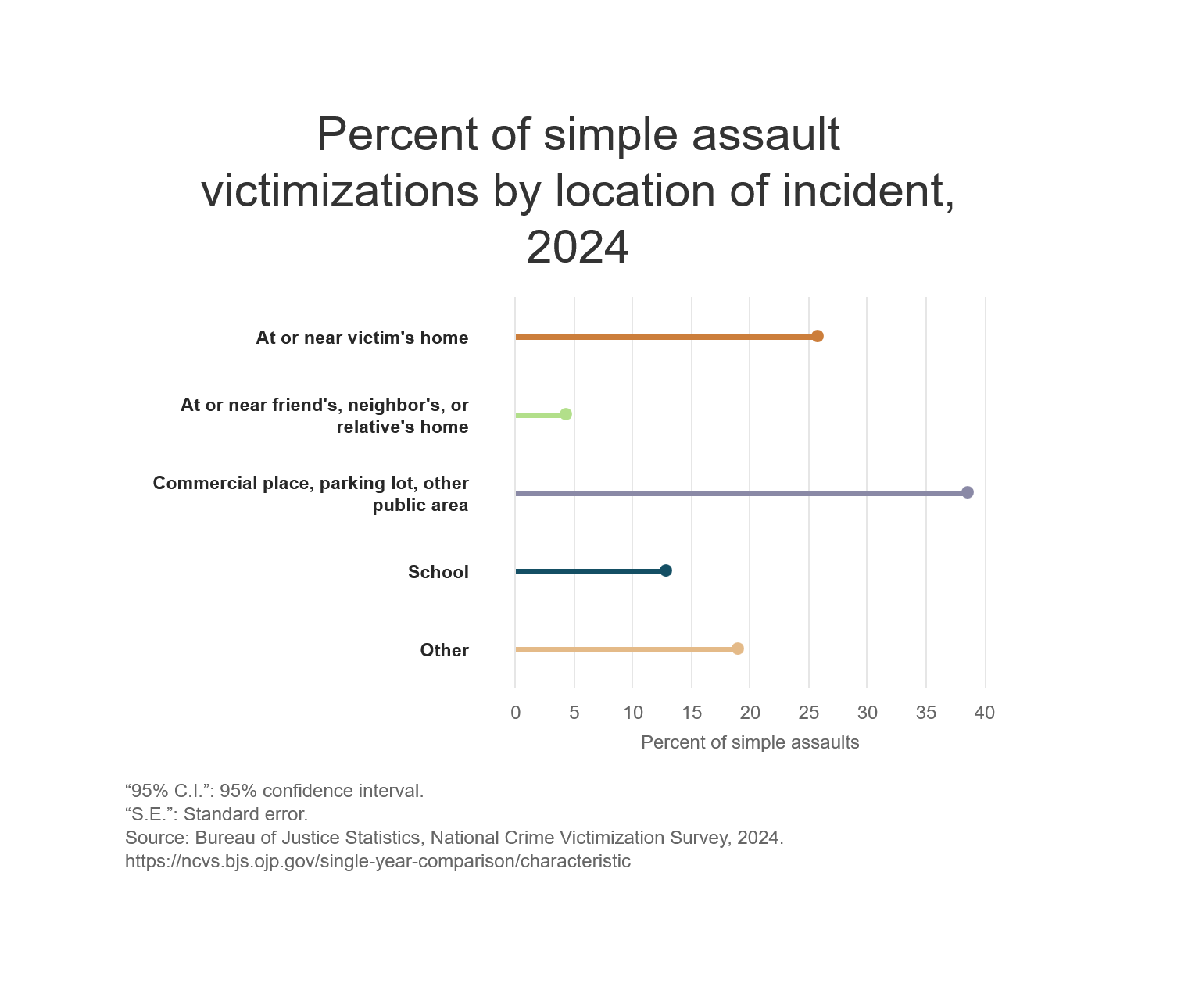
Source: Bureau of Justice Statistics, National Crime Victimization Survey.
Figure 2: Simple Assault Victim-Offender Relationship, 2024
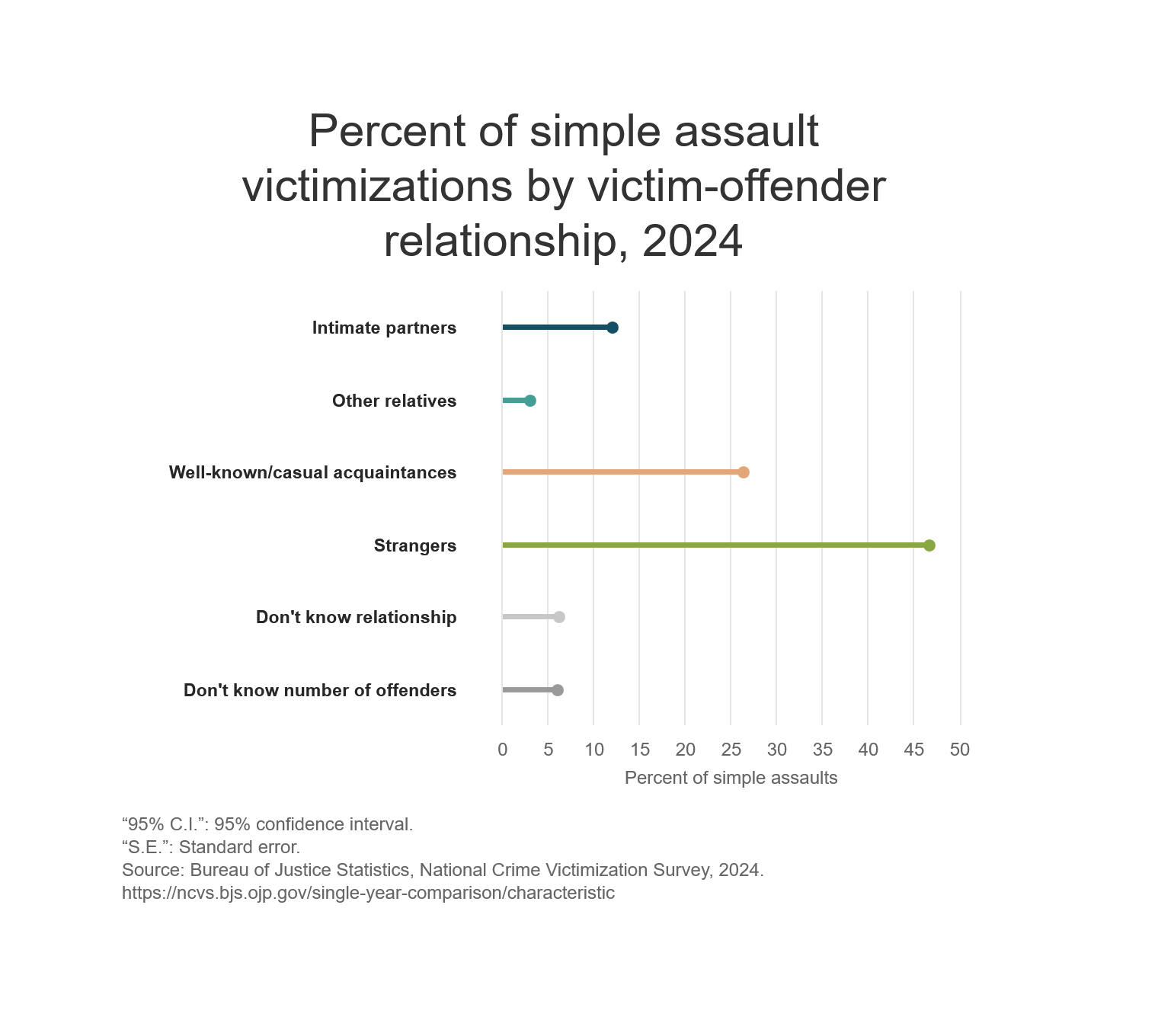
Source: Bureau of Justice Statistics, National Crime Victimization Survey.
Rape & Sexual Assault Statistics
Sexual violence remains an important personal safety concern.
The 2024 NCVS estimated approximately 560,890 rape or sexual assault victimizations, representing a rate of 2.0 victimizations per 1,000 people age 12 or older.
The NCVS also reports that the majority of violent victimizations are not necessarily committed by complete strangers. Understanding the relationship between victims and offenders can be an important part of personal safety education.
Figure 3: Rape & Sexual Assault Victim Demographics, 2024

Source: Bureau of Justice Statistics, National Crime Victimization Survey.
Figure 4: Rape & Sexual Assault Victim-Offender Relationship, 2024

Source: Bureau of Justice Statistics, National Crime Victimization Survey.
An Important Reminder
Statistics about sexual assault should never be interpreted as placing responsibility on victims. The responsibility for a crime always belongs to the person who commits it.
Personal safety education should focus on awareness, preparedness, access to resources, and supporting survivors, not on blaming victims for the circumstances surrounding an assault.
Ohio Crime Statistics
While national crime statistics provide useful information about broader trends, crime can vary significantly from one community to another. For Ohio residents, looking at state and local data can provide additional context about crime in the areas where they live, work, and travel.
The FBI’s Crime Data Explorer allows visitors to explore reported crime information by state and law-enforcement agency. You can use the tool to view Ohio data and, where available, explore information for individual communities and agencies.
It’s important to remember that reported-crime statistics represent incidents reported to law enforcement. They do not include every crime that occurs, and they should not be interpreted as a prediction of an individual’s likelihood of becoming a victim.
For a broader picture of crime and victimization, the National Crime Victimization Survey (NCVS) provides information about violent and property crimes experienced by individuals, including incidents that were and were not reported to police. However, the NCVS is designed to provide national estimates rather than detailed statistics for individual Ohio communities.
Explore Ohio Crime Data
For the most current reported-crime information, visit the FBI’s Crime Data Explorer and select Ohio or a specific law-enforcement agency.
FBI Crime Data Explorer:
https://cde.ucr.cjis.gov/
Remember: Crime statistics are one source of information—not a guarantee of safety or danger. Staying aware of your surroundings, understanding your environment, having a personal safety plan, and knowing your available options can all contribute to being better prepared.
Reported Crime Trends
The FBI’s Crime Data Explorer provides more recent information about crimes reported to law enforcement.
As of August 15, 2026, the FBI’s Crime Data Explorer showed that reported U.S. violent crime trends for the period from May 2025 through April 2026 were lower than the comparable prior period, including declines in reported murder, rape, robbery, and aggravated assault.
This is an important distinction: crime can be declining overall while individuals can still face meaningful risks in their communities and daily lives.
National statistics do not necessarily reflect conditions in a particular neighborhood, city, or state.
For current reported-crime information, visit the FBI’s Crime Data Explorer.
What Crime Statistics Mean for Personal Safety
Crime statistics aren’t meant to create fear. They can help us understand why preparation and awareness matter.
A practical approach to personal safety includes:
Stay Aware
Pay attention to your surroundings, particularly when entering or leaving a location, walking through parking lots, using your phone in public, or traveling alone.
Trust Your Instincts
If a situation feels uncomfortable or unsafe, give yourself permission to leave. You do not need to remain in a situation simply because you don’t want to appear rude.
Have a Safety Plan
Think ahead about what you would do if you encountered an unsafe situation. Know where you can go, who you can contact, and how you would get help.
Know Your Options
Personal safety tools can be one component of a broader safety plan. Depending on your circumstances and local laws, options may include personal alarms, pepper spray, stun devices, or other lawful self-defense products.
Learn How to Use Your Equipment
Simply carrying a self-defense product does not guarantee that it will be effective when you need it. Understanding how your product works and following the manufacturer’s safety instructions are important parts of responsible ownership.
Personal Safety Is About More Than Statistics
No statistic can tell you exactly when or where a dangerous situation will occur.
The goal of understanding crime data isn’t to live in fear. It’s to become more informed and prepared.
Awareness + Preparation + Education = Greater Personal Safety
At Lioness Defender, our mission is to help people feel more confident about taking an active role in their personal safety.
Reliable Crime Data Resources
For the most current crime information, we recommend using official government sources.
FBI Crime Data Explorer
The FBI’s Crime Data Explorer provides reported crime information, national trends, state and agency data, and downloadable datasets.
Bureau of Justice Statistics
The Bureau of Justice Statistics publishes the National Crime Victimization Survey, which provides information about criminal victimization whether or not incidents were reported to police.
2024 Criminal Victimization Report
The Bureau of Justice Statistics’ Criminal Victimization, 2024 report provides the latest finalized NCVS estimates currently available.
Stay Informed. Stay Aware. Stay Prepared.
Personal safety begins long before an emergency occurs.
Take the time to understand your surroundings, learn practical safety strategies, and choose personal safety products that fit your needs and circumstances.
Explore Lioness Defender’s personal safety products and resources to find tools designed to help you feel more prepared and confident.
Disclaimer
This page is provided for general informational and educational purposes only and does not constitute legal advice, law-enforcement advice, or professional safety advice.
Crime statistics are estimates and may be updated or revised by the agencies that collect and publish them. Different sources may use different methodologies, definitions, reporting requirements, and populations when measuring crime.
Lioness Defender, LLC does not guarantee the accuracy, completeness, or currentness of information presented on this page. For the most current statistics, please refer to the original government sources.
The availability, possession, carrying, and use of self-defense products may be subject to federal, state, and local laws. Customers are responsible for understanding and complying with all applicable laws.